 English
Views: 0 Author: Site Editor Publish Time: 2026-06-04 Origin: Site


Stair Chair choices can make or break emergency evacuations. Which type suits your operation best? Stair chairs are vital for safely moving patients on stairs. Manual and powered options each have unique benefits and challenges. In this post, you’ll learn their differences, key features, and how to choose the right stair chair for your needs.
Manual stair chairs are simple, non-powered devices designed to help transport patients or individuals up and down stairs safely. Typically, they feature a lightweight frame built from durable materials like aluminum or steel, often equipped with wheels and tracks to glide over steps. The design emphasizes portability and ease of use, making them a staple in emergency medical services and rescue operations.
Key features include:
Foldable frames for compact storage and transport
Handles at both ends for two-person operation
Track or wheel systems to navigate stairs smoothly
Safety straps to secure the patient during movement
Their straightforward design means no motors or batteries are involved, relying entirely on human strength and coordination.
Manual stair chairs offer several benefits:
Lower Cost: They are generally less expensive upfront compared to powered models, making them accessible for smaller operations or as backup equipment.
Portability: Lightweight and foldable, these chairs are easy to carry and store in ambulances, fire trucks, or medical facilities.
Simplicity: With no complex electronics or batteries, they require minimal maintenance and are always ready for immediate use.
Reliability: They function without dependence on power sources, so they work in any situation, including power outages or battery failures.
These advantages make manual stair chairs a practical choice for many emergency responders, especially when budgets or storage space are limited.
Despite their benefits, manual stair chairs have notable drawbacks:
Physical Strain: Operators must exert significant effort, especially when moving heavier patients or navigating long staircases. This can increase risk of musculoskeletal injuries such as back strain.
Teamwork Required: Typically, two or more trained personnel are needed to safely operate the chair, which may not always be feasible in urgent situations.
Slower Evacuations: The reliance on human power can slow down patient transport, which is critical during emergencies.
Limited Load Capacity: Manual chairs generally support lighter weight limits compared to powered alternatives.
These limitations mean manual stair chairs may not be ideal for frequent use or scenarios involving heavy or vulnerable patients.
Manual stair chairs are often used in:
Emergency Medical Services: For quick patient evacuation when powered options are unavailable or as backup tools.
Fire Rescue: When stairwells are the only evacuation route and simplicity is essential.
Hospitals and Assisted Living Facilities: For short-distance patient transfers on stairs where powered chairs are not justified.
Low-Budget or Low-Frequency Operations: Situations where investment in powered chairs is not practical.
In many cases, manual chairs serve as reliable, cost-effective tools for occasional or low-risk stair transport needs.
Tip: Train your team regularly on proper lifting techniques and teamwork to minimize injury risk when using manual stair chairs.
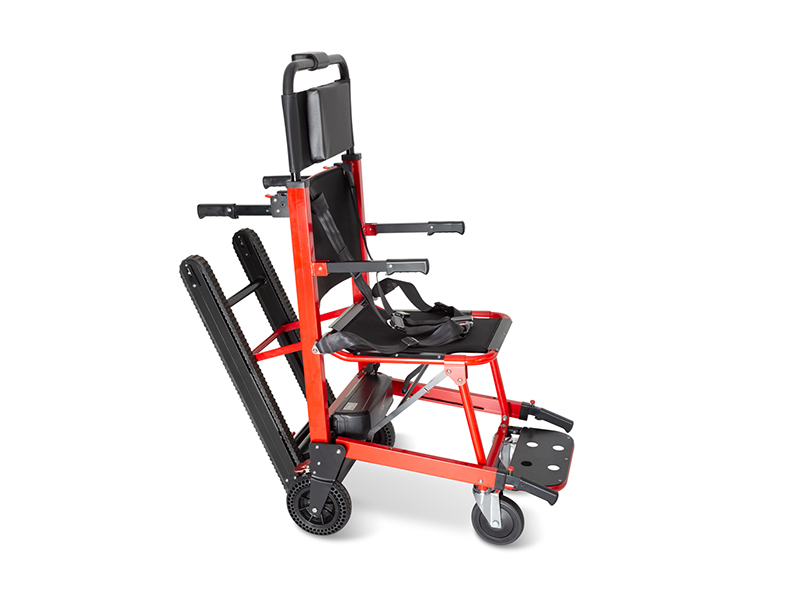
Powered stair chairs use battery-operated motors to assist in moving patients up and down stairs. These batteries typically power track systems or motorized wheels that glide smoothly over stair edges. The technology includes:
Rechargeable lithium-ion batteries providing long-lasting power for multiple evacuations.
Electric motors that control ascent and descent speed for safety and stability.
Track or caterpillar drive systems that distribute weight evenly and maintain traction on stairs.
Control handles with easy-to-use buttons or levers for operator guidance.
Safety sensors to prevent sudden movements or slippage during transport.
This integration of electronics and mechanics reduces the physical effort required from operators, allowing safer and faster patient movement.
Powered stair chairs offer several key advantages:
Lower Physical Strain: The motor does most of the heavy lifting, greatly reducing back and shoulder stress for operators.
Faster Evacuations: Motorized assistance speeds up stair navigation by up to 30%, critical during emergencies.
Higher Load Capacity: Many models support heavier patients, sometimes up to 500 lbs or more.
Single-Operator Use: Unlike manual chairs needing two or more people, powered chairs often allow one person to manage transport safely.
Built-In Safety Features: Features like automatic braking and speed control improve patient and operator safety.
These benefits enhance operational efficiency and reduce injury risk, making powered chairs ideal for frequent or high-stakes use.
Despite their advantages, powered stair chairs come with some challenges:
Heavier Weight: Batteries and motors add weight, making the chair itself heavier to carry when not in use.
Maintenance Needs: Regular charging, battery replacement, and mechanical upkeep are necessary to ensure reliability.
Higher Initial Cost: Powered models typically cost significantly more upfront than manual chairs, which may impact budgets.
Battery Life Concerns: Dependence on battery charge means chairs must be monitored and charged to avoid failure during use.
Training Requirements: Operators need training to use controls effectively and safely.
These factors require careful planning and resource allocation before adopting powered stair chairs.
Several powered stair chair models stand out in the market:
Model Name | Load Capacity | Battery Life | Unique Features |
|---|---|---|---|
MOBI EZ Power Stair Chair | Up to 500 lbs | Up to 100 floors per charge | Lightweight design, compact folding, easy controls |
Evac+Chair 3000 | 400 lbs | 2-3 hours continuous use | Automatic braking system, ergonomic handles |
Stryker Stair-PRO | 350 lbs | 6 hours standby | Adjustable seat, integrated safety straps |
Ferno PowerMate | 500 lbs | 4 hours continuous | Remote control operation, reinforced frame |
These models combine durability, safety, and performance, catering to different operational needs.
Tip: Regularly schedule battery checks and maintenance for powered stair chairs to ensure they perform reliably during emergencies.
Manual stair chairs require significant physical effort from operators. Carrying patients up or down stairs can cause back, shoulder, and knee strain. The risk of musculoskeletal injuries increases, especially during prolonged or frequent use. Teamwork is often necessary to safely maneuver the chair, adding complexity and potential for coordination issues.
Powered stair chairs reduce operator strain by using motors to assist movement. The mechanical help lessens lifting effort and distributes weight evenly. This lowers the chance of fatigue and injury. Operators can often manage powered chairs solo, reducing the number of personnel needed and minimizing physical stress.
Manual stair chairs typically take longer to navigate stairs due to reliance on human strength and coordination. Evacuation times can increase, which is critical in emergencies where every second counts. Slower movement may also increase patient discomfort or risk.
Powered stair chairs improve evacuation speed by up to 30%, according to studies. Motors provide smooth, consistent motion, allowing faster stair navigation without compromising safety. This efficiency can be life-saving during urgent evacuations and helps maintain workflow in busy operations.
Manual chairs have simple designs with basic safety straps but lack advanced features. Their safety depends heavily on operator skill and teamwork. Compliance with safety standards relies on proper training and maintenance.
Powered stair chairs come equipped with built-in safety features such as automatic braking, speed control, and stability sensors. These features help prevent sudden movements or slippage, enhancing patient and operator safety. Many models meet or exceed regulatory standards, supporting compliance with workplace safety laws.
Research shows powered stair chairs reduce operator injury risk by decreasing physical exertion. For example, a 2022 Emergency Medical Research Alliance study found powered chairs cut responder fatigue by 40%. Evacuation times dropped by about 30% compared to manual chairs.
Injuries related to manual chair use remain a concern, especially in high-frequency or heavy-load scenarios. Powered chairs offer a safer alternative, particularly in demanding environments like hospitals, fire rescue, and EMS.
Tip: Prioritize powered stair chairs for frequent or heavy patient transports to reduce injury risk and improve evacuation speed.
Manual stair chairs come with a lower initial price tag, often making them the go-to choice for operations on tight budgets or those needing backup equipment. Their simple design and lack of batteries or motors keep manufacturing costs down. A basic manual stair chair can cost several hundred dollars, depending on materials and brand.
Powered stair chairs, however, require a bigger upfront investment. The inclusion of motors, rechargeable batteries, and advanced safety features drives the price higher, often reaching into the thousands. This higher initial cost can be a hurdle for small organizations but reflects the added technology and benefits they provide.
While manual chairs are cheaper to buy, their total cost over time can be higher. Frequent use means more physical strain on staff, leading to injuries, lost workdays, and potential compensation claims. Manual chairs also require more personnel for operation, increasing labor costs.
Powered stair chairs, despite their higher price, often deliver better long-term value. Reduced operator strain lowers injury risk and related costs. Faster evacuations improve productivity and patient outcomes. Maintenance costs, such as battery replacements and servicing, should be factored in but usually remain manageable with proper care.
Injuries from manual chair use can be costly. Back strains and musculoskeletal disorders result in medical expenses, worker’s compensation, and lost productivity. These hidden costs add up, especially in high-use environments like hospitals or fire rescue teams.
Powered stair chairs help mitigate these risks by reducing the physical effort needed. Operators experience less fatigue and fewer injuries, preserving workforce health and minimizing downtime. The faster patient movement also means more efficient operations, potentially saving money during critical emergencies.
When budgeting, consider not just purchase price but also training, maintenance, and indirect costs like injuries and lost time. Manual chairs require basic training but depend heavily on teamwork and physical ability. Powered chairs need operator training on controls and battery management.
A balanced budget approach might involve investing in powered chairs for frequent, high-risk use and keeping manual chairs as backups or for occasional tasks. This strategy helps manage costs while maximizing safety and efficiency.
Tip: Factor in injury-related expenses and productivity gains when comparing manual and powered stair chair costs to make a well-rounded investment decision.
Manual stair chairs are straightforward to operate but require proper training to ensure safe handling. Operators must learn correct lifting techniques and coordinate well with teammates. Since manual chairs demand physical effort, training often focuses on teamwork and injury prevention.
Powered stair chairs, while more complex, feature intuitive controls such as buttons or levers. Operators need specific training on battery management, motor functions, and safety features. However, once trained, powered chairs allow single-person operation, reducing the need for multiple responders.
Training programs for powered chairs usually take longer but improve overall safety and efficiency. Both types benefit from regular refresher sessions to maintain skills and confidence.
Manual stair chairs excel in portability. Their lightweight, foldable design makes them easy to carry and store in tight spaces such as ambulances or small storage rooms. They can be deployed rapidly without worrying about battery charge or maintenance.
Powered stair chairs are heavier due to batteries and motors. While many models fold compactly, their increased weight can make carrying more challenging. Storage spaces must accommodate charging stations to keep batteries ready. Despite this, powered chairs remain transportable and suitable for various environments.
Choosing between portability and power depends on your operation’s space and mobility needs.
Manual stair chairs suit short-distance evacuations, lighter patients, or situations where teamwork is readily available. They work well as backup devices or in low-frequency emergencies. Their simplicity ensures reliability when technology may fail.
Powered stair chairs shine in frequent, high-stakes emergencies requiring rapid evacuations, heavier patient transport, or single-operator use. They reduce responder fatigue and speed up patient movement, critical in fire rescues or hospitals with multi-level layouts.
Operations with diverse scenarios often benefit from having both types available to match the situation.
In busy settings like hospitals or fire departments, efficiency and safety are paramount. Manual stair chairs can slow workflows due to physical strain and need for multiple operators. Fatigue may lead to longer rest periods and increased injury risk, impacting overall productivity.
Powered stair chairs improve workflow by enabling faster evacuations and reducing operator fatigue. Single-person operation frees up staff for other tasks, enhancing resource allocation. Their safety features minimize accident risks, keeping operations smooth.
Investing in powered chairs can yield significant gains in high-demand environments despite higher upfront costs.
Tip: Regularly train staff on both manual and powered stair chair use to ensure smooth, safe operations across diverse emergency scenarios.
In emergency medical services (EMS) and fire rescue, stair chairs are essential tools. They help move patients safely through stairwells when elevators are unavailable. Manual chairs are common in smaller or budget-conscious agencies. They offer reliability and portability during quick evacuations. However, powered stair chairs are increasingly preferred for their ability to reduce operator fatigue and speed up patient transport. Firefighters and EMS crews often face heavy, urgent loads where powered chairs improve safety and efficiency. Single-operator use of powered models frees up personnel for other critical tasks during emergencies.
Hospitals and assisted living facilities frequently use stair chairs for patient transfers between floors. Manual stair chairs remain popular for low-frequency use or short distances. Their lightweight design and ease of storage suit these environments. Powered stair chairs shine in busy hospitals with multiple daily stair transports. They handle heavier or less mobile patients more safely. Their built-in safety features and smooth operation help reduce injury risk to both patients and staff. Assisted living facilities also benefit from powered chairs when evacuating residents quickly during drills or real emergencies.
In commercial buildings, stair chairs assist security and medical teams during evacuations or medical incidents. Manual chairs are often stored as backup equipment due to their low cost and portability. Powered stair chairs suit high-rise office buildings or hotels where rapid evacuation is critical. Residential use, such as in multi-story homes or assisted living residences, typically involves manual chairs for occasional needs. However, powered chairs are gaining traction for their ease of use and safety, especially for heavier or less mobile individuals.
Regulations increasingly emphasize minimizing manual handling risks in stair transport. Occupational health and safety standards encourage using mechanical aids like powered stair chairs to reduce injury potential. For example, many jurisdictions require risk assessments that favor powered solutions in high-use or high-risk environments. Compliance with these requirements protects organizations from liability and promotes worker safety. Facilities with frequent stair evacuations or heavy patient loads often adopt powered chairs to meet these standards. Manual chairs may remain acceptable in low-risk, infrequent situations but carry higher injury risks.
Tip: Evaluate your facility’s emergency scenarios and regulatory obligations to choose stair chairs that ensure compliance and maximize safety for patients and operators.
Choosing between manual and powered stair chairs starts by understanding your facility’s specific needs. How often will the chair be used? In high-frequency environments like busy hospitals or fire departments, powered stair chairs offer clear benefits. They reduce physical strain and speed up patient movement, making them ideal for frequent use. Conversely, facilities with occasional stair transport needs—such as small clinics or residential settings—may find manual chairs sufficient. Consider the typical patient weight, stairwell design, and the number of staff available for operations. These factors help determine which chair aligns best with your daily demands.
Safety is paramount when selecting stair chairs. Manual models require significant operator strength and teamwork, increasing injury risk during prolonged or heavy use. Powered chairs reduce this risk by assisting movement, lowering operator fatigue and potential musculoskeletal strain. Assess your operation’s risk factors: frequent evacuations, heavy or immobile patients, and staff injury history. If your facility prioritizes minimizing workplace injuries and enhancing patient safety, powered stair chairs often provide a safer choice. However, manual chairs remain practical where risks are lower or as backup equipment.
Budget constraints influence many purchasing decisions. Manual stair chairs have a lower upfront cost, making them attractive for smaller operations or as secondary options. However, consider long-term costs such as staff injuries, lost workdays, and slower evacuation times, which may raise overall expenses. Powered chairs require a higher initial investment but can offer better value through enhanced safety, efficiency, and reduced injury-related costs. Reliability also matters—manual chairs are simple and low-maintenance, while powered chairs need battery care and periodic servicing. Balance your budget by weighing these performance and reliability factors against your operational needs.
Many organizations find value in combining both manual and powered stair chairs. Use powered chairs for frequent, heavy, or critical patient transports, ensuring faster and safer evacuations. Retain manual chairs as backups or for lighter, less frequent tasks. This strategic integration maximizes safety and efficiency while managing costs. Training your staff on both types ensures flexibility and preparedness across different scenarios. Additionally, having manual chairs on hand provides a reliable option during power failures or maintenance periods for powered chairs.
Tip: Conduct a thorough risk and usage assessment before purchase to select stair chairs that best fit your facility’s operational demands and safety goals.
Manual stair chairs are simple, portable, and cost-effective but require teamwork and physical effort. Powered stair chairs reduce operator strain, speed up evacuations, and offer advanced safety features. For frequent or heavy use, powered chairs are recommended, while manual chairs suit occasional needs or backup roles. Future stair chair technology will focus on enhanced safety and efficiency. Zhangjiagang Xiehe Medical Apparatus & Instruments Co., Ltd. provides reliable stair chair solutions that deliver value through durability and user-friendly design.
A: A stair chair is a specialized device designed to safely transport patients up and down stairs. Manual stair chairs rely on human strength and teamwork, while powered stair chairs use motors to assist operators, reducing physical strain and improving evacuation speed.
A: Powered stair chairs reduce operator fatigue, allow single-person operation, and speed up patient transport, making them ideal for frequent or heavy-duty use. Manual stair chairs are more portable and cost-effective but require more physical effort and teamwork.
A: Manual stair chairs generally cost several hundred dollars, while powered stair chairs can range into the thousands due to their advanced technology and features. Consider long-term value and injury-related costs when budgeting.
A: Manual stair chairs can cause operator strain and require multiple trained personnel to prevent injuries. Powered stair chairs include safety features like automatic braking and reduce physical risks for operators.
A: Regularly charge batteries, perform mechanical checks, and schedule maintenance to ensure powered stair chairs function reliably during emergencies. Proper training on battery management is also essential.


